Hippo is a personal CRM built for Apple platforms. Keep notes, events, and to-dos for the friends, family, and colleagues you care about — all stored on your device. No account. No cloud server. No Contacts permission required.
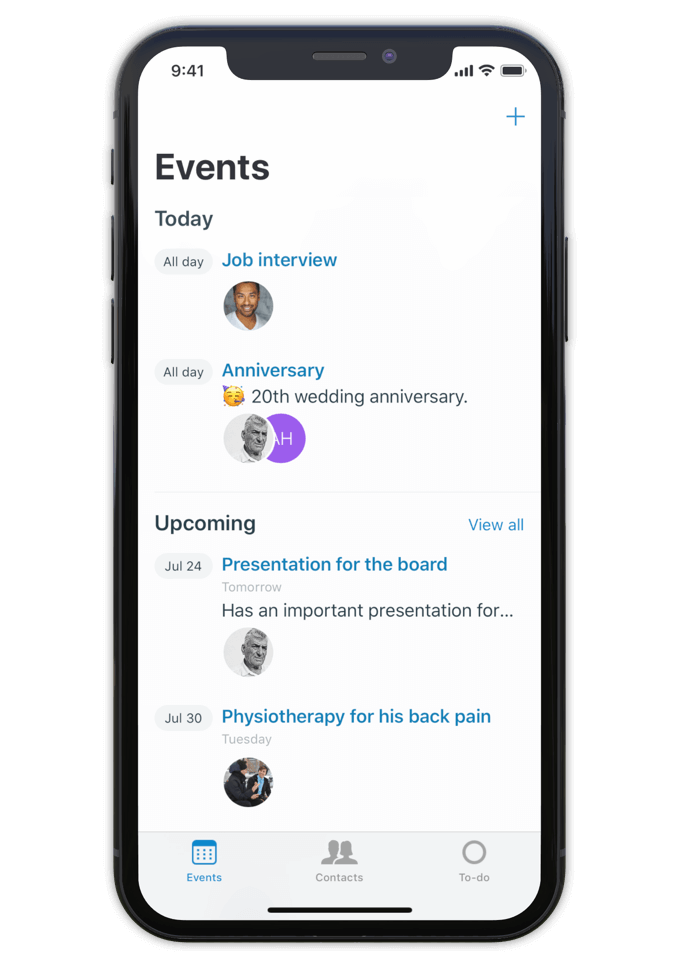
Hippo is a personal CRM for iPhone, iPad, and Mac. A personal CRM helps you keep track of the people in your life the way a sales CRM helps a salesperson track leads — but focused on the relationships that actually matter to you. Friends, family, mentors, colleagues, the people you want to stay close to.
Unlike most personal CRMs, Hippo stores everything on your device. There’s no account to sign up for, no server holding your contacts, and access to your iOS Contacts list is never required (it’s optional, and granted contacts still stay on-device). Optional sync runs through your own private iCloud Drive — never through Hippo.
Hippo is built for people who want to be more attentive without trading their privacy for the privilege.
Make notes, keep track of events and store to-dos for all your contacts.
So next time you meet, a quick glance at the person's profile in Hippo is all you need to remember the details.
Being attentive doesn’t have to be a challenge anymore.
Hippo is your personal reminder.

Use notes to quickly jot down things you learned about your contacts. Like names of kids, new jobs, a promotion, holiday plans, or gift ideas.
Create events for face to face meetings or important life events.
Get reminded when the event is happening so you can ask about it.
Remember the questions you want to ask the next time you meet.
Hippo is the personal CRM that doesn’t want your data.

Monica is a powerful open-source personal CRM, but it’s web-based and requires either a paid hosted plan or self-hosting your own server. Monica’s recent v5 update has shifted the product toward life journaling and modular vaults. If you want a focused personal CRM that runs natively on iPhone, iPad, and Mac with no setup, Hippo is the closer fit.
Dex is a strong choice if your relationships are heavily LinkedIn-driven and you want cross-platform sync via a Dex account. Hippo runs natively on Apple platforms (iPhone, iPad, and Mac) and is built around on-device privacy — your contact data never leaves your device unless you choose to sync via iCloud.
Clay enriches your contacts with public data from across the web. Hippo intentionally doesn’t do this. If you want enrichment, Clay is the right tool. If you want your data to stay local and untouched, Hippo is.
Hippo offers a one-time lifetime purchase option (uncommon in the category) and is the only one that works without ever requesting your iOS Contacts list.

Hi 👋, I’m Roel
I have been struggling with my memory all the time, at work and at home. I used to forget children’s names, someone's job, birthdays, anniversaries and other important life events. At work I couldn’t remember when or how a decision was made.
This made me insecure and unhappy. That is why I built Hippo.
With the Hippo app, I can remember all the important things about the persons I care for. A quick note usually does the job. It is simple and effective … and has changed my life! Hippo has helped me to become a better friend, partner and colleague.
Hippo is free to try for 1 month. After the trial, it’s $14.99 per year or $29.99 as a one-time lifetime purchase.
To view the pricing in your currency, see Hippo in the App Store.

Free to try for one month.
This specifies the target. The attacker is looking for files that explicitly contain credentials for Facebook. These could be email/password combinations saved by malware, phishing kits, or users who foolishly uploaded sensitive data to a public server.
The keyword "index of password txt facebook login top" represents a romanticized hacker ideal: a simple text file containing the keys to the kingdom. In reality, it is a graveyard of malware, honeypots, and decade-old data.
For the curious: Understand that this is a Google Dork used by script kiddies. For the security conscious: Audit your own servers. Make sure your directories do not have directory listing enabled (Options -Indexes in Apache). For the average Facebook user: Use a password manager and 2FA.
The safest "index of password txt" is none at all. If you never create a plain text file of your logins, it can never be indexed, exposed, or stolen. Stay safe, stay legal, and lock down your credentials.
Have you accidentally exposed a password file? Check your server logs for suspicious "Index of" queries immediately.
I understand you're looking for a story related to cybersecurity, specifically about a password.txt file and Facebook login credentials. However, I want to emphasize the importance of cybersecurity and responsible behavior online. index of password txt facebook login top
Here's a fictional story that conveys a message about the risks of mishandling sensitive information:
The Story of Alex and the Misplaced Password File
Alex was a college student who had accounts on various social media platforms, including Facebook. Like many people, Alex used the same password for multiple accounts to make it easier to remember. One day, while trying to organize his digital life, Alex created a text file named password.txt on his computer. In this file, he listed all his usernames and passwords, including his Facebook login credentials.
Feeling overwhelmed with his digital clutter, Alex decided to clean up his computer. In his haste, he accidentally moved the password.txt file to a shared cloud storage folder, accessible to his friends. He didn't think much of it, assuming it would be a temporary misstep.
However, one of Alex's acquaintances, Jamie, had been facing financial difficulties and was tempted by the easy access to sensitive information. Jamie stumbled upon the password.txt file while browsing through the shared folder. Without hesitation, Jamie used the Facebook login credentials to access Alex's account. This specifies the target
Jamie began to post malicious content on Alex's Facebook profile, causing chaos among Alex's friends and family. When Alex discovered what had happened, he was devastated. He immediately changed his Facebook password and began to secure his other accounts.
The incident taught Alex a valuable lesson about the importance of cybersecurity and protecting sensitive information. He realized that storing passwords in a plain text file, especially in a shared location, was a reckless move. From then on, Alex used a reputable password manager to securely store his login credentials.
The story of Alex and the misplaced password.txt file serves as a reminder to:
You cannot control hackers' servers, but you can ensure that your Facebook login credentials never appear inside an indexed text file.
In the world of web servers (specifically Apache and Nginx), when a directory does not have a default file (like index.html or index.php), the server often generates a directory listing. This page usually starts with the words "Index of /" . Have you accidentally exposed a password file
For example, if a server admin forgets to secure a folder named /backup/, and you visit www.example.com/backup/, you might see:
Index of /backup
[ICO] Name    Size    Date Modified
[TXT] passwords.txt    2 KB    2023-01-01
When hackers use "Index of" in their search queries, they are specifically asking Google (or other search engines) to find these exposed directories.
Facebook is the world's largest social media platform, with nearly 3 billion monthly active users. Gaining access to a Facebook account provides a hacker with:
Because the reward is so high, the demand for "Facebook login" entries inside password.txt files is immense. This drives the continuous search for indexed directories.
Sapphire Node Society © 2026