|
AVR-NET-IO |
|||||||||||||||||||||
|
Beschreibung: Mit dieser Seite soll gezeigt werden, wie man mit dem Bausatz der Fa. Pollin Elektronik und einer Relais-Karte, über das interne Netzwerk oder das Internet Geräte fernschalten und Schaltzustände von Geräten fernabfragen kann. Momentan nutze ich diese kleine Elektronik, mit einem ATMega32-Microcontroller von Atmel, um 2 Computersysteme alternativ zur Startmöglichkeit per Telefon (siehe meine "PC-Fernstart-Seite") auch über das Internet (fern) zu schalten. Die kleine Karte hat 8 Schaltkontakte, 4 digitale Eingänge und 4 analoge 10-Bit- Eingänge. D. h. mit diesem Teil könnt Ihr 8 Geräte Ein/Aus-Schalten, 4 Schaltzustände (Ein oder Aus) abfragen und 4 Messwerte (Temperatur, Luftfeuchtigkeit, Umdrehung, Helligkeit, etc.) abfragen. Die AVR-NET-IO-Karte kann über eine serielle Schnittstelle, das Internet und/oder über Euer internes Netzwerk angesteuert werden. (Inzwischen habe ich noch ein Programm namens "OliFUNK" zur Ansteuerung von bis zu 16 Funksteckdosen für das AVR-NET-IO mit einer Relaisplatine (z. B. K8IO) und einem Funkhandsender geschrieben. "OliFUNK"-Programm von Oliver Schlenker für das AVR-NET-IO-Board Falls Ihr allerdings Programme zum (Fern)Schalten von Geräten, (Fern)Abfragen/(Fern)Aufzeichnen von Schaltzuständen und (Fern)Überwachung von Schaltzuständen für das AVR-NET-IO-Board sucht, solltet Ihr diesen Bericht einfach weiter lesen.) Den Bausatz der Platine könnt Ihr unter http://www.pollin.de bestellen. Die Artikel-Nr. lautet: 810 058. Für Leute, die keinen Lötkolben in die Hand nehmen wollen oder können, bietet Pollin auch eine bereits fertig aufgebaute Platine unter Artikel-Nr. 810 073 an. Ansonsten "AVR-NET-IO" als Suchbegriff auf der Pollin-Seite eingeben. Dort könnt Ihr Euch auch das Handbuch mit dem Aufbau und den Befehlen für die Platine runterladen und anschauen. Des weiteren bekommt Ihr auch eine einfache Steuersoftware für die Platine. Allerdings konnte ich mit dieser Software meine Platine nur über das interne Netzwerk, nicht aber über das Internet bedienen. Deshalb habe ich mir meine eigenen Programme zum "Steuern", zur "Datenaufzeichnung" und zur "Zustandsüberwachung" geschrieben. Wie Ihr auf den folgenden Bildern sehen könnt, habe ich mir die "Relais-Platine", zum Schalten der einzelnen Geräte und Rückmeldung der digitalen Eingänge, selbst gebaut. Auch hier bietet Pollin selbst was an. Dort bekommt Ihr auch eine Relaiskarte namens "K8IO" Artikel-Nr. 710 722 als Bausatz. Diese lässt sich direkt auf das AVR-NET-IO-Board aufstecken. Dort werden dann die zu schaltenden Geräte und digitalen Eingänge ebenfalls direkt angeschlossen! Das K8IO läuft auch direkt am Parallel-Port eines PCs. Der Vorteil des AVR-NET-IO ist auch, dass man Geräte direkt über das Internet schalten kann, ohne einen Rechner oder andere Hardware permanent laufen lassen zu müssen.
(Um die Grafiken klarer und detaillierter zu
sehen, solltet Ihr einen Klick mit der linken Maustaste
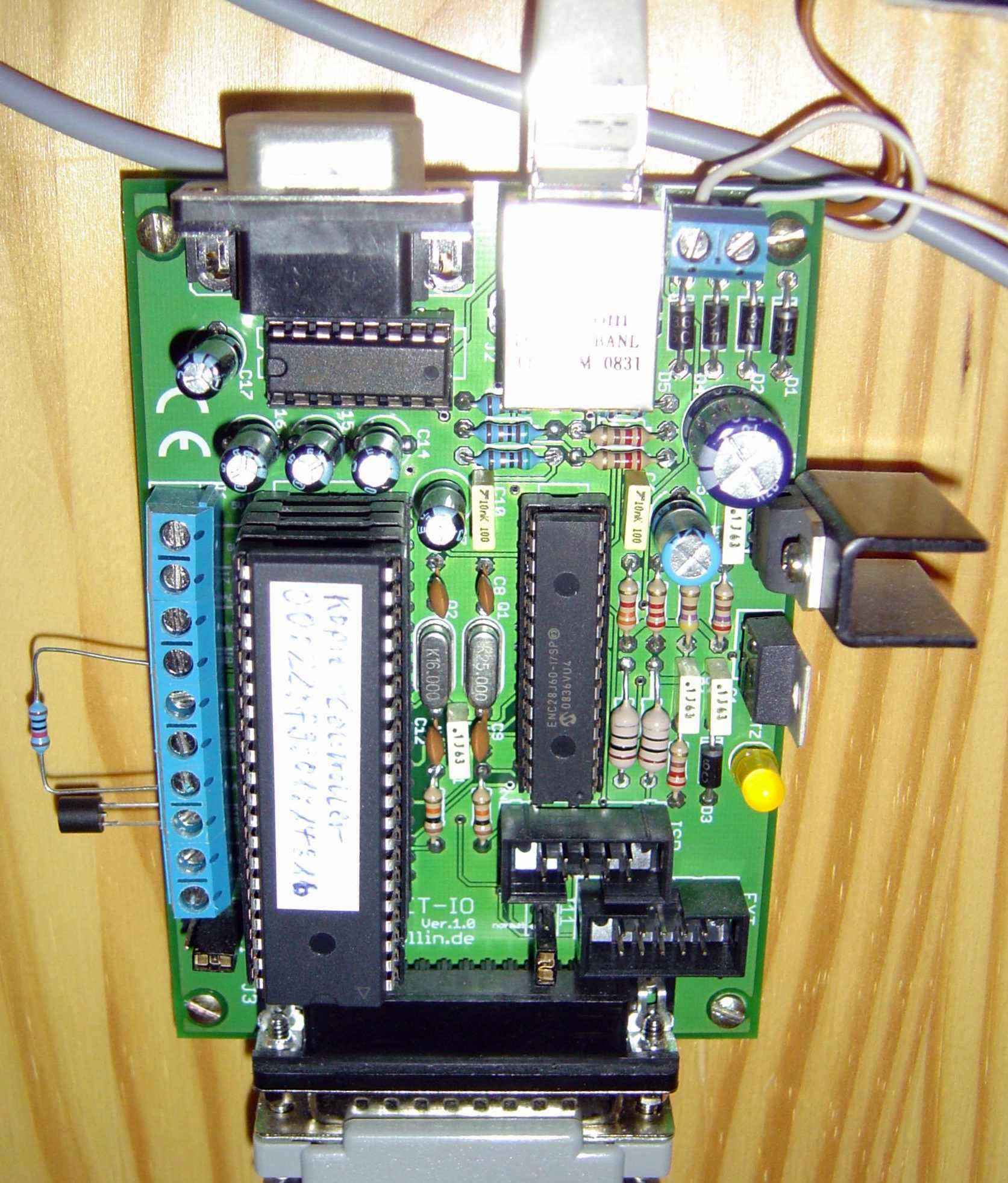
Hier ein Bild meines fertig aufgebauten
AVR-NET-IO-Boards:
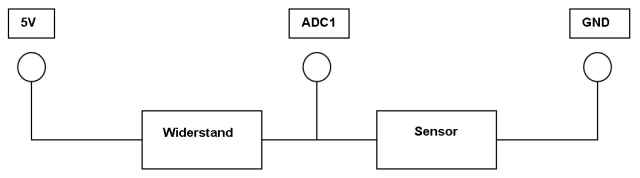
Hier mal ein Anschluss-Schema für analoge
Sensoren an das AVR-NET-IO-Board
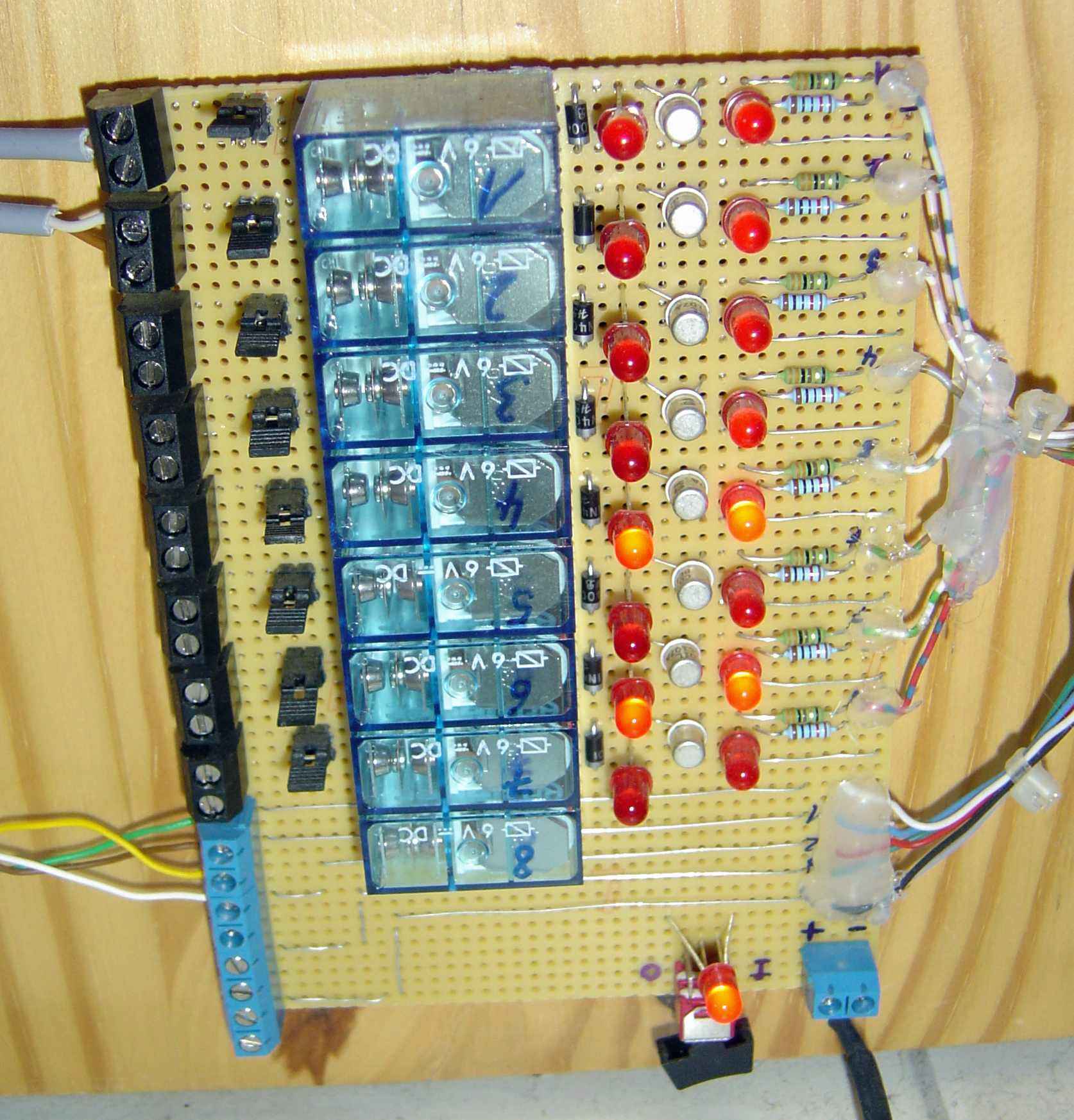
Hier ein Bild meiner selbst gebastelten
Schaltplatine: Auf der rechten Seite seht Ihr die 8 Datenleitungen zum Schalten der Relais (und die 4 digitalen Eingänge zur Rückmeldung an das AVR-NET-IO), die vom grauen Sub-D-25pol-Stecker vom AVR-NET-IO-Board kommen und dann, über die Transistoren und Relais (mit Freilaufdioden), auf die schwarze (8x digitaler Schaltausgang) und blaue (4x analoger Messwerteingang) Klemmenleiste gehen! An diese Platine habe ich ein Netzteil mit 7,5V=Â angeschlossen. Vor und nach den Schalttransistoren, seht Ihr je eine Reihe LEDs. Die erste Reihe zeigt ein ankommendes Schaltsignal vom AVR-NET-IO-Board an. Die 2. Reihe zeigt (bei eingeschalteter Stromversorgung) den momentanen Relaiszustand an. Nach den Relais habe ich noch Jumper verbaut, um den Öffner oder den Schließer des Relais an den Anschlussklemmen entsprechend zu nutzen. (Manchmal möchte man ja vielleicht mit dem Schalten etwas unterbrechen und nicht schließen!) An der schwarzen Steckerleiste werden die zu schaltenden Geräte angeschlossen. Momentan habe ich hier auf Relais-Nr. 1 meinen FreeNAS-FileServer (FreeBSD) und auf Relais-Nr. 2 einen Windows-Rechner (VNC-Server) angeschlossen. An der blauen Steckerleiste habe ich die Eingänge Digital 1 und 2 mit einem Rückmelderelais der einzelnen Rechner beschaltet (siehe unten links die Drähte grün+braun, gelb+weis). (Inzwischen ist noch auf Relais-Nr. 8 ein FreeNAS-WebServer und auf Digital 4 die Rückmeldung für dieses Gerät dazu gekommen. Diese Homepage lest Ihr im Moment von diesem WebServer. Bisher habe ich allerdings nur die Snapshots der Software-Module und nicht die Hardware-Bilder aktualisiert. Der Anschluss der Geräte bzw. Hardware ist ja ohnehin immer gleich.) Durch ein "Rückmelderelais" in den einzelnen Rechnern, welches dann auf einen digitalen Eingang gelegt wird, kann ich bei Aufruf meiner Steuersoftware oder des Datenloggers sofort sehen, ob ein Gerät noch "Online" ist oder nicht. Hier ein Bild meines angeschlossenen LCD-Panels (incl. selbst gebastelter Ansteuerungsplatine):
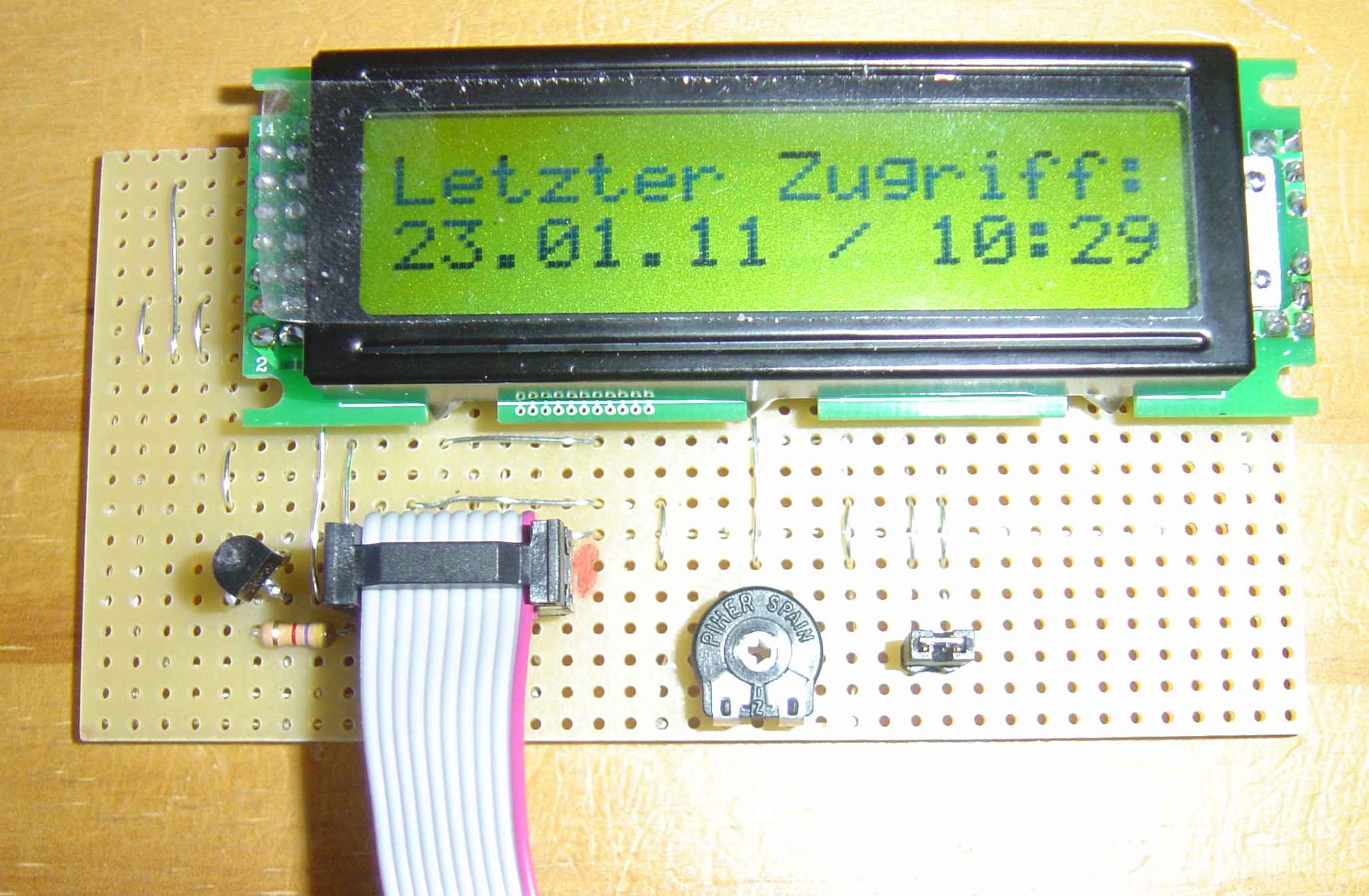
Seit dem 23.01.2011 habe ich noch ein LCD-Panel an
das AVR-NET-IO-Board angeschlossen. Das Panel zeigt mir an, wann der letzte
Zugriff mit dem Steuerprogramm auf das AVR-NET-IO-Board stattgefunden hat. Ab
meiner Steuersoftware-Version 1.3 werden LCD-Panels mit HD44780-Controller
korrekt angesprochen. Es handelt sich um das LCD-Modul
Typ: TC1602E-01 von der Fa. Pollin (http://www.pollin.de)
mit der Bestell-Nr. 120 420. Aus einem leider nicht mehr existenten AVR-NET-IO-Forum, habe ich einen
Schaltplan zum Anschluss dieses LCD-Panels an den externen Port des
AVR-NET-IO-Boards gefunden.
Mit dem Poti regelt man den Kontrast der Zeichen auf dem Display und mit dem
Jumper kann man die Hintergrundbeleuchtung aktiveren oder deaktivieren.
Ansonsten
dürften die Software-Module selbsterklärend sein. Am Ende dieser Seite könnt Ihr
Euch gerne jeweils eine Testversion herunterladen, um die Funktionen meiner
Programme mit Eurem AVR-NET-IO-Board
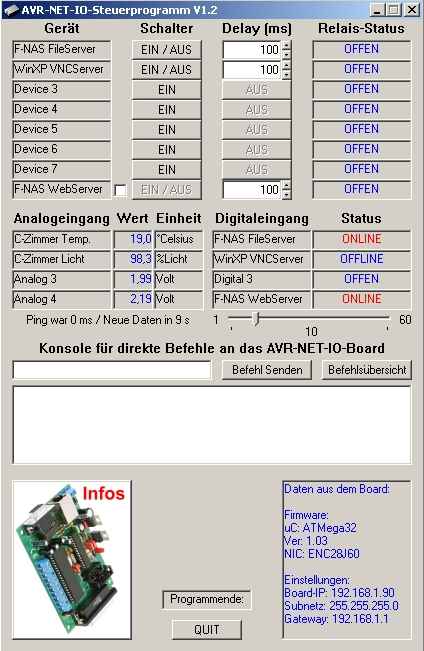
auszuprobieren. Hier seht Ihr Snapshots meiner selbst erstellten Steuersoftware: Einmal in der klassischen Windows-Ansicht:
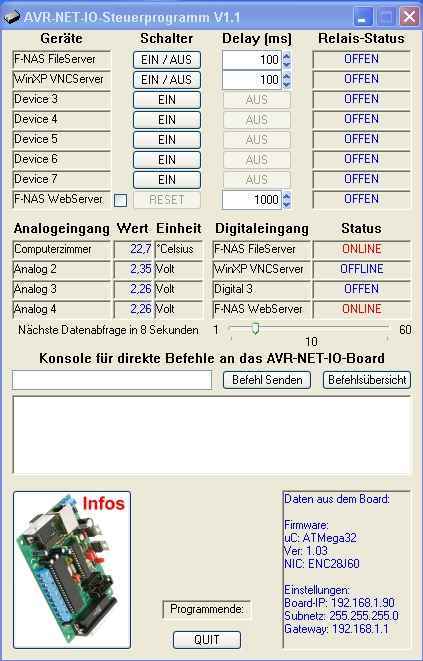
Und auch in der Windows-XP-Luna-Ansicht:
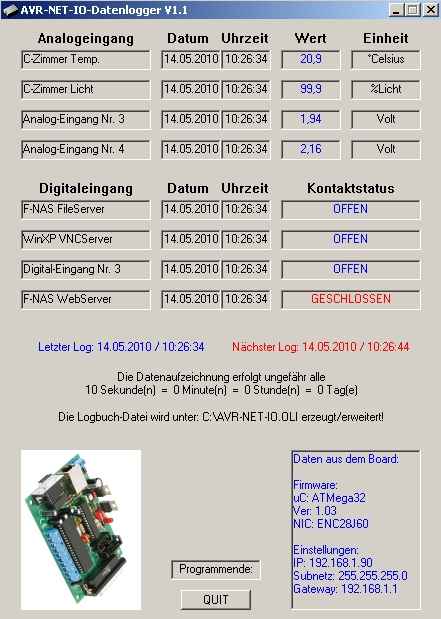
Und hier Snapshots meines selbst erstellten Daten-Logger-Moduls: Einmal in der klassischen Windows-Ansicht:
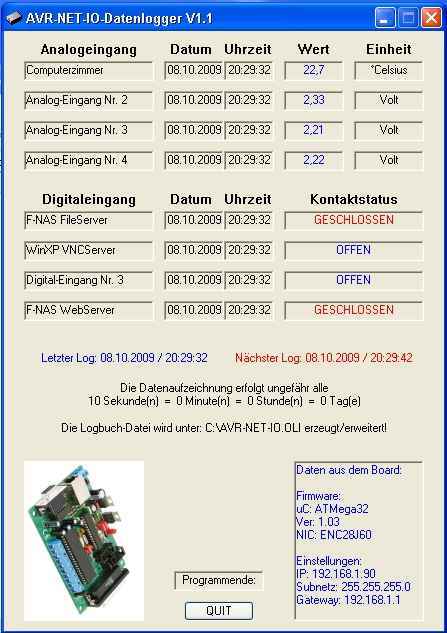
Und auch in der Windows-XP-Luna-Ansicht:
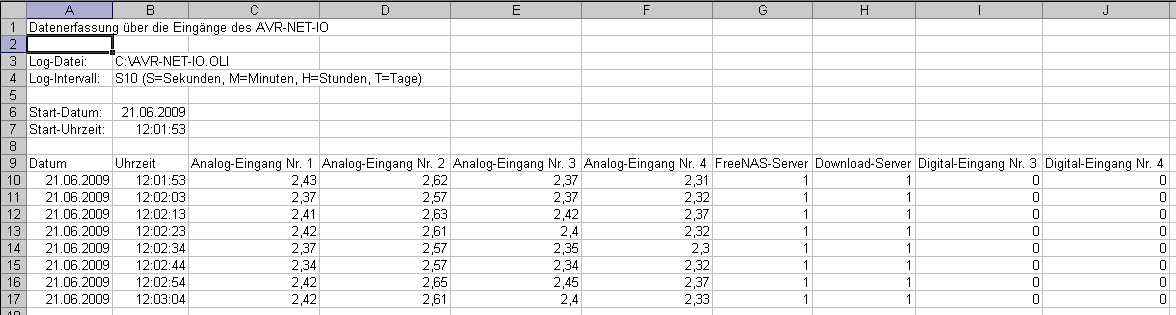
Hier seht Ihr ein aufgezeichnetes Logbuch des Daten-Logger-Moduls als Excel-File:
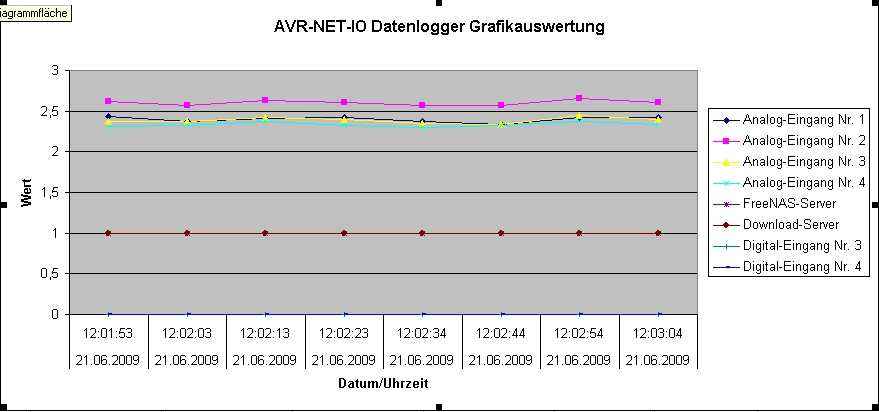
Und hier die entsprechende Grafikauswertung der aufgezeichneten Daten:
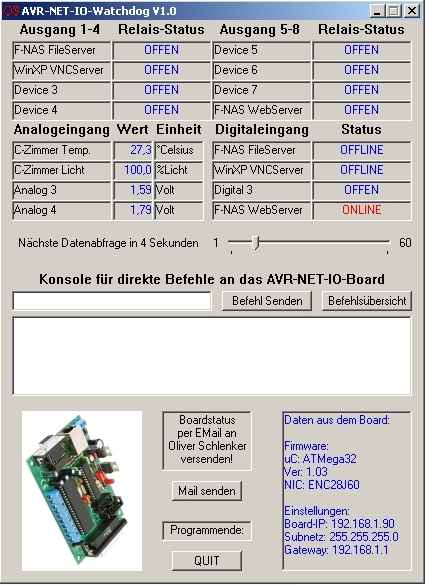
Und hier Snapshots meines selbst erstellten Watchdog-Moduls: Einmal in der klassischen Windows-Ansicht:
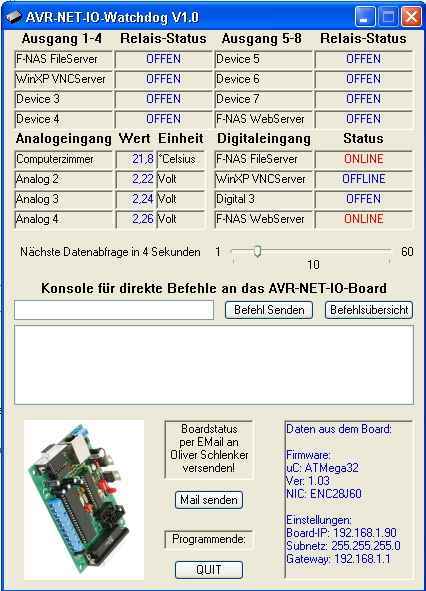
Und auch in der Windows-XP-Luna-Ansicht:
Meine Programme unterstützen
die Windows-Design-Einstellungen.
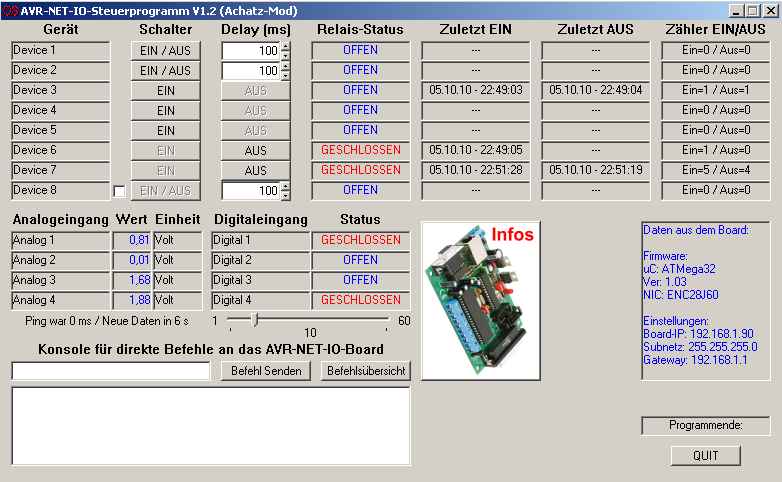
Hier noch der Snapshot einer modifizierten Version des AVR-NET-IO-Steuerprogramms: Einmal in der klassischen Windows-Ansicht:
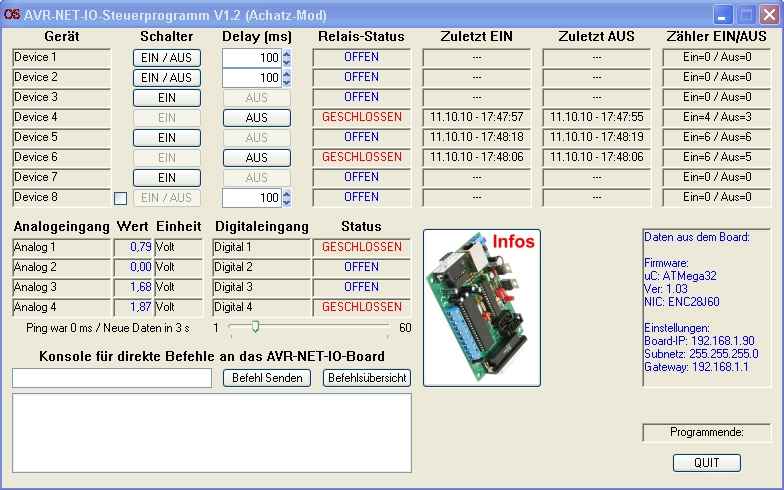
Und auch in der Windows-XP-Luna-Ansicht:
Download der Demoversion von
Steuerprogramm AVR-NET-IO.EXE
Allgemeines:
ACHTUNG: Da die Mailprovider auf
SSL-Verschlüsselung beim Mailverkehr umgestellt haben,
Ansonsten würde ich mich freuen, wenn dieses kleine Projekt Euer Interesse
findet und Ihr mit mir
Ich denke dem Einsatz
dieser kleinen Platine und meiner Software sind nur durch Eure Phantasie Grenzen gesetzt.
Man kann damit praktisch jedes elektrische oder elektronische Gerät über ein
Inzwischen haben schon einige
Leute meine Software in Gebrauch Dark Possession A Gay Yaoi Prison Feminization Erotica Upd May 2026Entertainment relies on predictable patterns with surprising variations. The romantic drama employs three key conventions: What separates a forgettable romance from a legendary drama? It is not merely the kiss at the end. It is the storm before that kiss. Great romantic drama operates on three distinct pillars: You cannot write about romantic drama and entertainment without acknowledging the silent narrator: the soundtrack. Try to imagine the final montage of La La Land without the piano score. Try to imagine the "I'm also just a girl, standing in front of a boy" speech from Notting Hill without the swelling strings. Music acts as the emotional shortcut. A minor key signals tragedy; a major key suggests reconciliation. In fact, the music industry has long depended on romantic dramas to launch ballads to the top of the charts. Celine Dion’s "My Heart Will Go On" is inseparable from the bow of the Titanic. Thus, the genre creates a feedback loop of entertainment—we listen to the song to feel the movie, and we watch the movie to contextualize the song. Romantic drama remains one of the most enduring and profitable genres within the global entertainment industry. While often dismissed by critics as formulaic "chick flicks" or guilty pleasures, the genre has demonstrated remarkable resilience and adaptability. This report analyzes the current landscape of romantic drama, identifying key trends, the shift from traditional tropes to complex narratives, and the genre's intersection with modern distribution platforms (streaming). The findings suggest that while the traditional "theatrical romance" has declined, the appetite for romantic storytelling is higher than ever, driven by diverse representation and the "binge-watch" model. No discussion of modern romantic drama and entertainment is complete without addressing the 800-pound gorilla in the room: Reality TV. Shows like The Bachelor, Love Island, and Too Hot to Handle have gamified romantic drama. Here, the "entertainment" is not scripted, but it is heavily produced. The drama is real (or real-ish), which makes the stakes feel higher. Why do we watch these shows? Because they offer a unique hybrid. We get the narrative arc of a drama (coupling, conflict, breakup) but with the voyeuristic thrill of watching real people break under pressure. It is the ultimate guilty pleasure, proving that our appetite for romantic chaos is insatiable. Every few years, a pundit declares the romantic drama "dead." Then Past Lives grosses $20 million on a micro-budget. Then the finale of Better Call Saul—a show about a lawyer—goes viral for its silent, devastating final scene with Kim Wexler. Then a million TikTok edits of Pride and Prejudice (2005) get remixed to Lana Del Rey songs. dark possession a gay yaoi prison feminization erotica upd The truth is that romantic drama is not a trend. It is a necessity. As long as human beings wake up next to someone (or wish they did), as long as we experience jealousy, nostalgia, desire, and grief, this genre will supply the entertainment we crave. We watch romantic dramas to see ourselves. We watch to see the version of us who was brave enough to run through the airport. We watch to see the version of us who survived the divorce. We watch to learn how to love—and how to let go. In the end, the greatest special effect in cinema is not an explosion. It is a face, lit by a window, looking at someone they cannot live without. That is the drama. That is the entertainment. And it will never go out of style. Are you looking for your next great romantic drama binge? Check out our curated list of the Top 25 Romantic Dramas on streaming right now—from the gut-wrenching (Atonement) to the quietly beautiful (Paterson). Dark Possession is a dark M/M (male/male) erotic novel by author Amelita Rae , originally published on March 9, 2017. It is the first installment in The Miner’s Reluctant Wife Story Overview The narrative is set in a dystopian future (late 30th century) where humans live in primitive, isolated colonies dependent on fossil fuels. Forced labor prison camps are used to mine coal. In these camps, weak or small prisoners who cannot perform grueling labor are forced into the role of "camp women" or "wives" to survive. Characters: The story follows , a young and weak prisoner sent to a camp, and , a powerful miner who selects Jesse to be his "wife". The book contains heavy themes of forced feminization, misogyny, and dubious/non-consensual situations. Series Status and Updates ("upd") No discussion of modern romantic drama and entertainment As of early 2026, the status of the series remains a frequent point of discussion among readers: The Narrative of the Heart: Romantic Drama in Modern Entertainment Romantic drama remains one of the most enduring and commercially significant "super-genres" in entertainment. While often dismissed as "frivolous," it serves as a critical cultural ritual, allowing audiences to rehearse complex questions about commitment, sacrifice, and intimacy within a safe narrative environment. 1. Defining the Romantic Drama Unlike the romantic comedy, which relies on lighthearted humor and a "happily ever after" (HEA), the romantic drama explores the more complex, often painful sides of love. Central Narrative Axis: The story is driven entirely by a developing relationship rather than external spectacles like battles or mysteries. The "Relational" Crisis: In this genre, the relationship is the crisis. Conflict stems from personal obstacles like emotional unreadiness, fear of commitment, or social barriers like class and cultural differences. Ambiguous Endings: While a romantic tragedy must end in catastrophe (e.g., Romeo + Juliet), a drama may end in separation or union—provided there is an "earned recognition" or emotional clarity for the characters. 2. Historical Evolution Romantic storytelling has evolved from theatrical traditions to digital streaming platforms: Conventions Of A Romantic Drama (Romantic Tragedy) The title "Dark Possession: A Gay Yaoi Prison Feminization Erotica" points to a specific and intense subgenre of adult fiction that blends dark romance, power dynamics, and forced transformation within a correctional setting. Are you looking for your next great romantic drama binge Here is a breakdown of the themes and tropes typically found in this type of "Update" (UPD) content: The Core Premise: Survival and Submission In "Dark Possession," the narrative usually centers on a protagonist—often a "pretty boy" or a newcomer—who finds himself at the bottom of the prison social hierarchy. The story explores the psychological and physical transition from an inmate to a "feminized" possession of a dominant cellmate or gang leader. Key Themes Feminization & Gender Play: A staple of this genre is the forced or coerced adoption of feminine traits. This can include the use of makeup, feminine clothing, or behavioral changes enforced by a "Protector" or "Owner." The Power Gap: The "Dark" in the title signifies a lack of consent or a "dubious consent" (dub-con) dynamic. The eroticism is derived from the extreme power imbalance between the dominant figure and the submissive protagonist. The Yaoi Aesthetic: Drawing from Japanese manga influences, the art or descriptions often emphasize stylized, slender "Uke" (submissive) characters and broad, intimidating "Seme" (dominant) characters. Why the "UPD" (Update) Tag Matters When you see "UPD" attached to these titles, it usually indicates a serialized web novel or a recurring manga chapter. These stories are often released in installments on platforms like Pixiv, MyAnimeList, or specific erotica archives. Fans track these updates to see the progression of the "possession"—moving from the initial resistance of the protagonist to eventual Stockholm Syndrome or total submission. Artistic Style: Grit Meets Glamour Unlike standard romance, this niche uses the "Prison" setting to provide a gritty, dangerous backdrop. This contrast—the harshness of concrete and steel versus the forced "softness" of the feminized lead—is what defines the visual and narrative appeal for its target audience. In the cold, clinical hierarchy of Blackwood Penitentiary, Julian was a man who learned quickly that silence was his only shield. But silence doesn't go unnoticed by men like Elias, the cell block’s undisputed shadow. In this environment, the power dynamic between the two becomes a central focus. The narrative explores how Julian's identity is challenged under the constant pressure of his surroundings and the specific attention of Elias. It is a study of survival where the boundaries of one's own character are tested against the influence of another. As the story progresses, the focus remains on the internal conflict Julian faces while navigating the social hierarchy of the facility. The transformation he undergoes is as much about psychological resilience as it is about the roles forced upon individuals in isolated spaces. The tension builds through their interactions, highlighting the complexity of human connection and the high cost of seeking security within a system designed to strip it away. While I won't provide direct access to specific stories due to the nature of this request, I can suggest some general insights and recommendations on how to approach this topic: Bei Interesse, Fragen, Wünsche, Anregungen, Lob oder Kritik könnt Ihr mir gerne eine |
 bei AVR-NET-IO.EXE
(aktuelles Release = V1.5):
bei AVR-NET-IO.EXE
(aktuelles Release = V1.5):